Solar eclipse glasses and eye safety
Looking at the Sun without the right filter can burn your retina in seconds, with no pain to warn you. Here is what NASA and the American Astronomical Society say actually keeps your eyes safe.
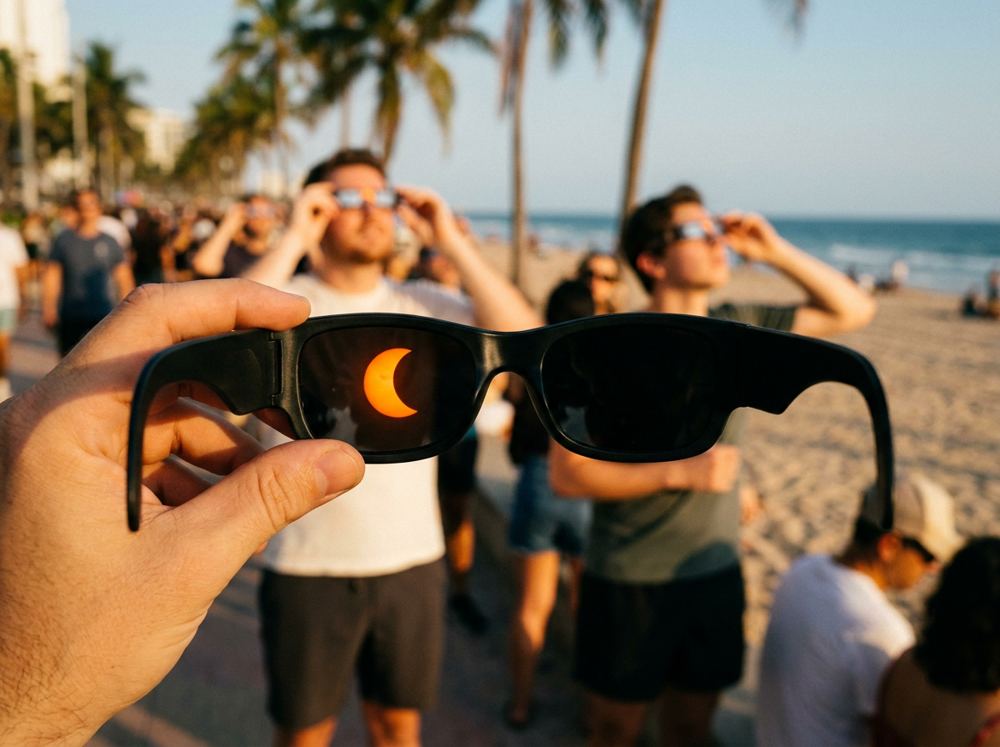
Safe
- Eclipse glasses or handheld viewers meeting ISO 12312-2, from a supplier on the AAS list
- Pinhole projection: looking at the Sun’s image on the ground, never through the hole
- Telescopes, binoculars and cameras fitted with a certified solar filter on the front
- Welding filters of shade 12 or darker
- Naked eyes only during totality, when the Sun is completely covered
Never safe
- Sunglasses of any darkness, stacked or not
- Smoked glass, exposed film, CDs, X-ray film, space blankets
- Eclipse glasses behind binoculars, a telescope or a camera viewfinder
- Your phone screen as a “filter”, or staring at a partial Sun through clouds
- Taking your glasses off at 99% coverage: the last sliver is still blinding
Check your eclipse glasses
Tick each one that is true. If any box stays empty, don’t use them.
Not yet: every item must be true before you look at the Sun.
What ISO 12312-2 means
ISO 12312-2 is the international standard for “filters for direct observation of the Sun”. A compliant viewer blocks nearly all visible sunlight and practically all ultraviolet and infrared. The Sun looks like a comfortable orange or white disc, and everything else disappears. The AAS points out that a printed ISO logo can be faked, which is why it keeps a list of suppliers whose products have been checked.
Why eclipses hurt eyes that normally cope
You never stare at the Sun on a normal day because it is too uncomfortable. During a deep partial eclipse the sky dims and your pupils open wider, while the uncovered sliver of Sun is just as bright per square degree as ever. The retina has no pain receptors, so solar retinopathy (a burn on the retina) can happen without any sensation, with blurred spots appearing hours later.
Using binoculars, telescopes and cameras
Optics gather far more light than your eye. A certified solar filter must sit over the front of the lens or telescope, so sunlight is filtered before it is concentrated. Never put eclipse glasses between an eyepiece and your eye. Phones generally survive a quick shot of the partial Sun, but a filter over the lens gives better photos and protects the sensor: see the photography guide.
Make a pinhole projector
- Take two sheets of stiff white card.
- Pierce a clean hole about 1–2 mm across in the middle of one sheet.
- Stand with your back to the Sun and hold the pierced card up so sunlight passes through the hole onto the second card.
- Move the cards apart to make the image bigger (and fainter). About 1 m apart gives an image roughly 1 cm across.
Colanders, straw hats and the gaps between tree leaves do the same thing, and throw dozens of tiny crescent Suns on the ground during the partial phases.
Totality: the one exception
Inside the path of a total eclipse there is a short window, from second to third contact, when the Sun’s surface is completely hidden. Only then is it safe, and worth it, to look with naked eyes at the corona. The moment the diamond ring flashes on the western edge, filters go back on. The contact times for your location are on each eclipse page.
Children
Supervise children the whole time. Make sure their glasses cover both eyes with no gaps, and that they understand not to peek around them. A pinhole projector is a good hands-on alternative for young kids.
Questions
What does ISO 12312-2 mean on eclipse glasses?
ISO 12312-2 is the international safety standard for filters used to look directly at the Sun. Glasses and handheld viewers that meet it block almost all visible light and virtually all harmful ultraviolet and infrared. NASA and the American Astronomical Society (AAS) recommend only viewers that meet this standard.
Are sunglasses safe for looking at an eclipse?
No. Ordinary sunglasses, even very dark or polarised ones, let through thousands of times too much sunlight. Stacking several pairs does not make them safe.
How do I know my eclipse glasses are not fake?
An ISO 12312-2 label alone is not proof, because counterfeits copy it. Buy from a manufacturer or dealer on the AAS list of suppliers of safe solar viewers. At home, you should see nothing through them except the Sun itself or something similarly bright, such as a halogen bulb filament. Ordinary lamps should look extremely dim or invisible.
Can I reuse old eclipse glasses?
Yes, if they meet ISO 12312-2 and are undamaged. The AAS says compliant glasses do not expire. Throw them away if the filter is scratched, punctured, torn or coming loose from the frame.
Can I look through binoculars or a camera with eclipse glasses on?
No. Concentrated sunlight from binoculars, a telescope or a camera lens will burn through the glasses’ filter and into your eye instantly. Optics need their own certified solar filter mounted on the front (Sun-facing) end.
When is it safe to look without protection?
Only during totality of a total solar eclipse, when the Moon completely covers the Sun’s bright surface. Put your viewer back on as soon as the first flash of sunlight reappears. In partial and annular eclipses it is never safe to look without a filter.
Is it safe to watch a lunar eclipse?
Yes. A lunar eclipse is just the Moon in Earth’s shadow and needs no eye protection at all.
Can I use welding glass?
Only welder’s filters of shade 12 or darker are safe to look at the Sun through, according to NASA and the AAS; shade 14 is the most comfortable. Most welding helmets are lighter than that, so check the number. If you are not sure, do not use it.
Sources: NASA Eclipse Safety; American Astronomical Society Solar Eclipse Task Force: eye safety and safe solar viewers. This page is general guidance, not medical advice. If you notice vision changes after an eclipse, see an eye doctor.